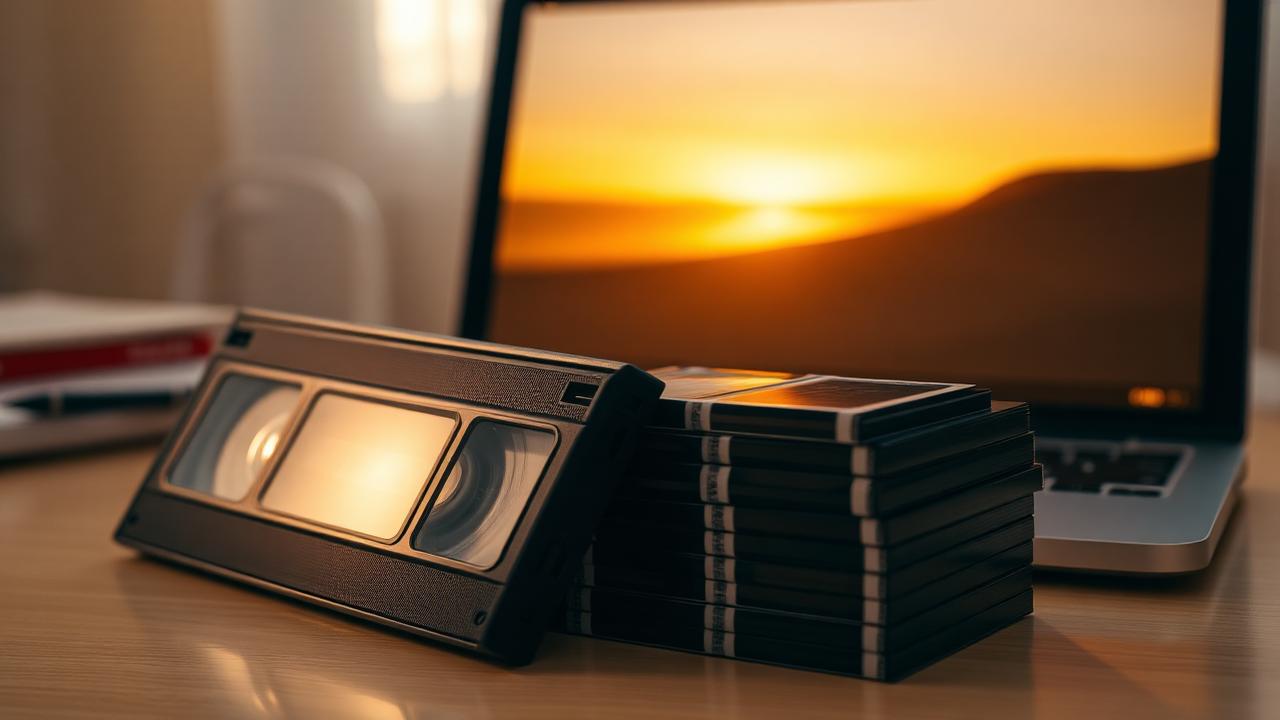
What actually happens to a VHS tape's picture quality over time
A short, non-technical explanation of why your VHS wedding video looks worse now than you remember.
7 min read
VHS tapes don't degrade dramatically. They degrade gradually and consistently, which is why the difference is so easy to miss until you try to watch one twenty years later.
A VHS recording is a thin magnetic coating stuck to a plastic ribbon. Everything that goes wrong with it comes down to one of three things: the coating losing its magnetism, the binder holding the coating on breaking down, or the ribbon itself stretching. Here is what each of those looks like on screen.
Colour bleed
The reds go first. If you look at an old VHS tape today, reds tend to smear sideways slightly, which is why old football footage looks so much worse than the goalkeeper's kit remembers.
VHS stores colour at far lower resolution than brightness, so colour information has the least margin for loss. As signal strength drops, the colour smears before the outlines do.
Tracking drift
The picture 'floats' up and down slightly as the tape stretches. On a modern flat-screen this becomes very obvious — the screen has no way to hide it the way a CRT did.
Tapes that were paused a lot, or left parked mid-reel for years, stretch unevenly, which is why the drift often clusters around the bits everyone watched most.
Audio hiss
The audio track on a VHS is much narrower than the video track, and picks up hiss disproportionately as the tape ages. Voices get muddy before the picture does.
For family tapes this matters more than picture quality. Nobody rewatches a christening for the sharpness — they rewatch it to hear someone's voice.
Sticky shed and mould — the two that need urgency
If a tape squeals in the machine, leaves brown residue on the heads, or smells faintly of wax crayons, the binder is breaking down. If you can see white or grey speckling on the edge of the tape pack, that is mould. Both get worse with every play and both can shed onto a VCR's heads, which then damages the next tape you put in.
These are the tapes to deal with first. Everything else can wait a year; these can't.
Where the tape was kept matters more than its age
A 1987 tape stored upright in a spare bedroom usually plays better than a 2001 tape stored flat in a loft. Heat accelerates binder breakdown, damp invites mould, and lying flat lets the tape pack settle unevenly. If you do nothing else, stand your tapes on their spine indoors.
The single best thing you can do
Play it once, all the way through, on a good VCR, and capture that playback. The next play, on any VCR, will be slightly worse.
That is also why we capture at the highest quality the tape can give on the first pass rather than 'having a quick look' first — every viewing spends a little of what's left.
Trusted with family archives
Umberdosh Restoration
We digitise family collections by hand from a home studio in Cambridgeshire — archival-grade scans, originals returned tracked and insured, and a fixed rate card so you know exactly what you're paying for.
Related guides across the whole Help hub: What to do with a parent's photos and papers after they move into care, Cleared the house, kept the box: what to do with inherited family photographs, You don't have to sort it all at once — a calm guide to inherited family archives, Grandma's boxes: where to start when you don't know what's inside, How to protect family photos and documents after a bereavement, without rushing, Found a box of old family photos while clearing a house — now what?, VHS to digital: DIY vs professional — an honest comparison, How much does it cost to digitise old family photos in the UK?, Can you still get VHS tapes played? Here's what's actually happening to old tape, 35mm slides in the loft: are they still worth saving?, Cine film, slides, cassettes: a plain-English guide to what you might find in an old box, Why acid-free sleeves matter more than people think, How archivists actually store family photographs (and how you can too), The mistakes that damage old photographs faster than time does, Should you ever throw away 'duplicate' family photos? An archivist's view, What museums do differently when handling old paper and photographs, How to start researching your family history from a single box of documents, What can a photograph actually tell a genealogist?, Common family stories that turn out to be (partly) true, How to research one specific family mystery without committing to a full family tree, The best gift for a parent who has everything: their own history, restored, A Christmas gift that isn't a thing: digitising a lifetime of family photos, How to split family photographs between siblings without falling out, What to keep and what to let go: deciding without regret, JPEG or TIFF? Choosing the right file format for scanned photographs, How long do digital files actually last? Backups explained simply, Scanning photos with your phone vs a flatbed: what you actually lose, Storing photographs in a damp British house: what actually works, Looking after 8mm and Super 8 cine film before it's digitised, Why the framed photos on your wall are fading faster than the ones in the box, How to date an undated photograph from clothing, cars and card stock, Recording the stories before they're lost: interviewing older relatives, A golden anniversary gift: their wedding album, restored and shareable